Contents
A scrap is easy to keep because it might be useful. The harder question is whether I will recognize its use later. I would rather retain a few pieces with enough context to compare them than fill a box with unidentified material that becomes another decision every time I open it.
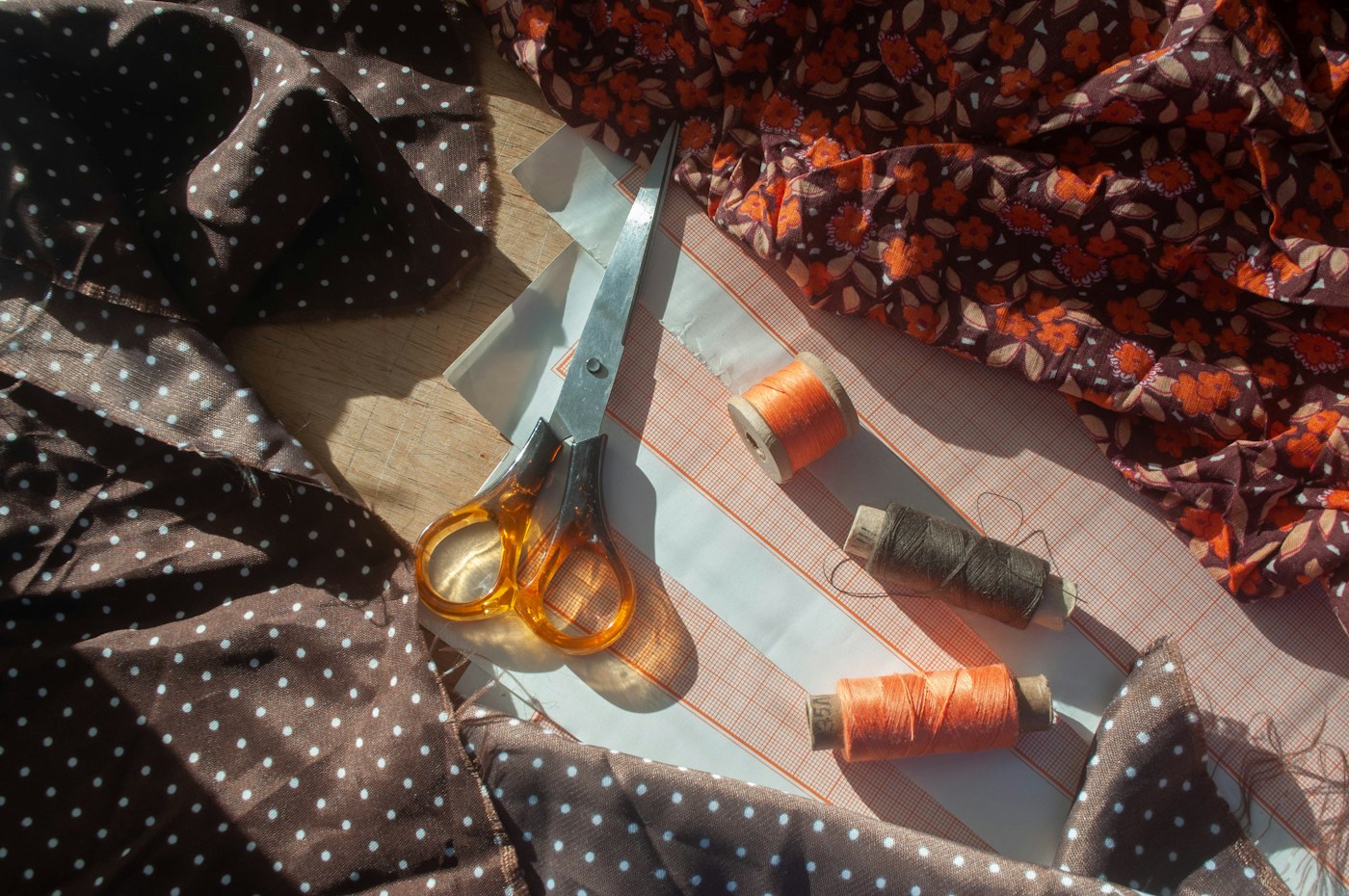
Imagine a modest scrap collection for ordinary clothing repairs: one woven cotton piece, one stretch material and a few lengths of thread. These are demonstration materials, not products I have tested. I will give them a simple record and a reason to stay.
Keep the information that makes the scrap useful
If a piece came from a labeled garment or a known purchase, I would preserve that information with it. Fiber content, construction, finish and any known care requirements can all help with a later comparison. A familiar color is not enough to identify a suitable patch.
The Patagonia fabric reference explains why construction and stretch matter to repair choices. I would keep those observations in the record without guessing what I cannot identify. “Fiber unknown; woven appearance” is more honest and useful than an invented material label.
Store a comparison, not a promise
A scrap can be a candidate for a repair without being pre-approved for every matching color. I would compare its thickness, movement and care needs with the actual garment when the task arises. A label should help that decision, not replace it.
Likewise, a piece useful for practice may not be suitable for the final item. I would distinguish those jobs. A stiff sample can demonstrate a stitch sequence while being a poor patch for a softer garment. Keeping the purpose clear avoids turning availability into compatibility.
Give each retained piece a small note
Here is a simple record for the invented cotton scrap. It leaves room for uncertainty and avoids a detailed catalog that takes longer to maintain than the collection itself. The identifier connects the note to the physical piece.
I would keep loose threads, pins and needles out of the scrap bundle. A material library should not become informal tool storage. If the piece needs a pin to hold its label, I would choose a safer labeling arrangement before putting it away.
Piece: C01
Origin: Known cotton garment offcut; retain label information.
Construction: Woven.
Movement: Compare with the intended repair, not assumed universal.
Care: Record available instructions.
Possible use: Practice or candidate patch for ordinary woven clothing.
Unknowns: Finish and exact compatibility with another item.
Use a sample to ask a limited question
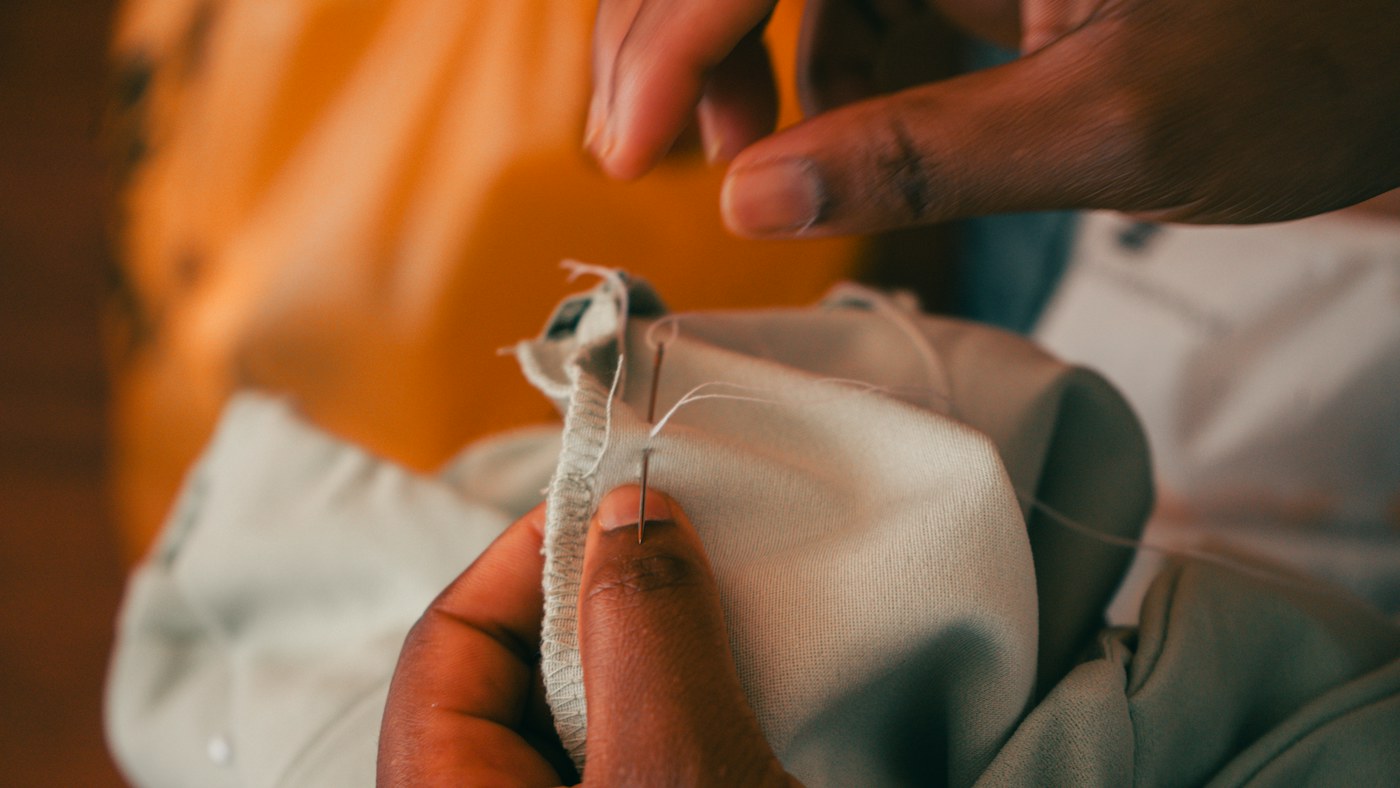
The needle-and-thread reference gives selection principles for the tool-material match. I would use a scrap to inspect that immediate interaction: does the needle pass with control, does the thread catch and does the sample gather? Those are useful observations with clear limits.
I would not call a few sample stitches a test of long-term wear or washing. If care compatibility matters, I need an appropriate way to assess it. If the actual item is valuable, specialist or outside my skill, a convenient scrap does not remove the reason to ask for help.
Set a physical boundary for the collection
I would choose a small container or folder arrangement that suits the available space. The boundary is a local household choice, not a universal amount of fabric a person should keep. When it becomes difficult to identify pieces, I would review them before simply adding another container.
The review can be straightforward: known compatible candidates, useful practice material and pieces with no clear role. I would not retain badly deteriorated or unsuitable material merely because discarding it feels inconsistent with repair. A manageable collection should support continued use, not create another unresolved pile.
Return the learning to the record
After a sample session, I would add a short factual note: what material was used, what method was attempted and what limitation was observed. I would avoid turning a narrow observation into “works on all cotton.” The context is what makes the note useful later.
If a piece is used in a real repair, I would keep relevant material information with the garment’s care context. That closes the loop between the scrap box and the item in use. The collection earns its place when it helps a specific decision, not because every offcut has been saved.
Build a material record from three different origins
I would compare three hypothetical pieces: an offcut kept with a labeled garment, a piece bought with material information and an attractive unknown scrap. They may all be worth retaining, but for different reasons. The first two offer context that can help assess a future repair. The third may suit a practice exercise while leaving compatibility unresolved. I would not flatten those differences into a single label such as useful fabric.
The record should preserve available information without improving it by guesswork. If a fiber description is known from a label, I would retain that source. If construction is identified by inspection, I would record the observation separately. If a care history is uncertain, the uncertainty remains. A material record should make the next question easier to ask, not produce an appearance of authority that exceeds what is known about the piece.
I would also note the piece's practical limitations. An irregular shape, a worn area or a small usable region can matter to future selection. The aim is not to measure every edge in a tiny household collection, but to avoid rediscovering the same obstacle each time the piece is considered. A brief description can distinguish a patch candidate from material retained only for learning a stitch. Those are both useful roles with different expectations.
The physical identifier needs to remain associated with the record safely. I would avoid leaving a loose needle or pin as the only way to hold a label. The collection should be understandable when opened by someone who did not arrange it. If the identifier falls away during ordinary storage, the system needs a simpler connection. A good record is valuable only when the person selecting material can reliably tell which piece it describes.
Compare a scrap with a particular garment
For an imagined woven trouser repair, I would compare construction, movement, thickness and care requirements with the candidate piece. A color match can be attractive while the material behaves differently. I would use the fabric reference to frame those questions and the actual repair method to decide what preparation is needed. The record supports the choice; it does not pre-approve the scrap for every garment sharing a common fiber name.
I would inspect whether the retained piece contains sound material in the region needed. A scrap from worn clothing may carry useful information and still be unsuitable in a damaged area. The next repair should not inherit unnoticed wear merely because the material has a known origin. I would consider its current condition as well as its label history. Provenance and physical suitability answer different parts of the selection question.
A compatible-looking piece can be tried in a relevant practice arrangement. I would note the layers and method used, observing immediate handling rather than claiming durability. If the sample gathers or the chosen thread catches, that helps identify a question before the actual garment is altered. If the sample differs substantially from the planned repair, I would retain that limitation. “Worked on a scrap” is not a sufficient conclusion without describing which scrap and what was observed.
I would select the final material only after those checks produce an understandable plan. If the candidate's care or movement remains unresolved, another material or a repairer may be more appropriate. The purpose of saving scraps is to support useful repairs, not to require every retained piece to become one. A collection earns its place when it offers informed options rather than pressure to use whatever happens to have been kept.
Keep practice material without confusing it with repair stock
A practice piece has a different job: make a movement or decision visible. A contrasting thread can help inspect the stitch path, and a manageable piece can expose tangles or tension. That setup may deliberately differ from a discreet finished repair. I would label it accordingly so that a successful practice exercise does not become an unqualified recommendation for the same colors, tools or materials on another item.
I would define the question before practicing. It might be understanding the direction of a backstitch, comparing how two needle choices pass or seeing whether a proposed edge treatment distorts the sample. A short exercise can answer one immediate question. It should not be described as a comprehensive test of washing, wear or strength. The useful limit is part of the observation and should remain attached if the sample is saved.
When an exercise is finished, I would decide whether its record will help later. A small labeled example of a technique can be useful; a pile of unidentified stitched scraps may only add another search problem. I would keep a representative sample where it has a purpose and put other material away safely after accounting for sharps. Retention should follow future use, not the fact that time has already been spent on the piece.
If another person uses the sample, they should know what it demonstrates. I would identify the method, material and point of interest. A sample showing stitch direction should not be treated as a finished-quality model of appearance. A sample comparing immediate handling should not be treated as evidence of garment durability. Clear context lets a modest exercise remain valuable without asking it to establish more than it actually inspected.
Review the box when it stops supporting selection
I would use retrieval as the trigger for a review. If selecting a known suitable piece becomes difficult because the container is crowded or labels have detached, the collection is asking for attention. I would not automatically add another box. First I would separate identified candidates, purposeful practice material and pieces with no current role. That distinction can reveal whether the problem is space, missing information or an unwillingness to make a retention decision.
The review should include condition. Retained material can become tangled, dirty or difficult to assess. I would avoid mixing loose sharps and unknown small parts into the fabric storage. The box should be safe to open and clear enough to inspect. An organizer that looks neat but conceals unidentified needles has not solved the practical task. The storage decision needs to account for the people who might handle the collection, not only the person who assembled it.
I would keep the physical boundary proportionate to the repairs actually undertaken. Someone doing frequent varied work may reasonably retain more than someone who occasionally sews a button. The useful amount is contextual, not a moral test of thrift. Discarding unsuitable deteriorated material does not undermine the purpose of repair. Keeping it indefinitely may instead make compatible material harder to find and the next manageable task harder to start.
A review ends when the retained pieces have understandable roles and can be found safely. I would leave a short convention for adding new pieces: identify what is known, state a plausible purpose and keep the connection to the material. That small rule can prevent the collection becoming mysterious again. The result is a source of options tied to real jobs, with enough context to compare them and permission to choose another route when none fits.
Give a retained piece an actual retrieval test
I would imagine the next repair beginning without a memory of today's sorting. Can I find the known woven candidate, identify its care context and distinguish it from the practice-only piece? The container does not need a complicated index if a few clear labels answer those questions. If opening it produces the same uncertainty as an unmarked bag of scraps, the record is not yet connected well enough to the material. I would repair that connection before adding another layer of categorization.
For the hypothetical pocket task, I would retrieve the candidate and compare its current condition with the record. A label can preserve origin but cannot guarantee the piece remains suitable after storage or previous use. I would inspect wear, usable area and the relevant movement again. That keeps retrieval from becoming automatic approval. The record saves rediscovering known context while the actual decision still considers the material now in front of the reader and the specific garment it might join.
I would then identify the question for a practice sample, if one is needed. Perhaps I want to inspect whether the selected stitch and thread gather the combined materials. The sample should resemble that arrangement closely enough for the immediate observation to matter. I would record that limited result and avoid giving it a broader name such as proven patch fabric. A useful scrap collection can hold both material knowledge and uncertainty without requiring every piece to carry a claim of tested performance.
If the candidate does not fit, I would put it back with its role still understandable or revise the record if the new observation matters. The failed match does not make the piece worthless; it may suit another ordinary task. Equally, I would allow a piece to leave the active collection when no plausible use remains. Retaining it solely because it has already been saved turns storage history into an obligation, which can make the next selection harder rather than support more thoughtful repair.
The collection passes its practical test when a reader can retrieve a candidate, understand what is known, inspect what remains and choose the next action. The outcome may be using it, practicing with it or choosing something else. That flexible endpoint is the reason to keep a small material record. It turns a scrap from an anonymous possibility into an informed option while leaving the repair itself accountable to the actual garment, method and care requirements.
Frequently Asked Questions
Q: Should I keep every offcut?
A: No. Keep pieces with a plausible use and enough context to assess them. A collection that is too mixed to search may make a repair harder to begin.
Q: Can matching color identify a suitable patch?
A: No. Compare construction, stretch, thickness, finish and care requirements as well as appearance. Color is one consideration among several.
Q: What if the fiber is unknown?
A: Record that uncertainty rather than guess. The piece may still serve as practice material, but a repair needing specific compatibility may require better documented material or advice.
Q: Does a successful practice stitch prove durability?
A: No. It gives a limited observation about handling on that sample. Long-term use, care and the actual garment construction introduce other questions.
Q: How should I label a small piece?
A: Use a simple identifier and a secure, safe record that stays with it. Avoid loose sharps in storage and keep the system proportionate to the size of the collection.
One thing to take forward
I would keep the scrap that comes with a question I can answer: what is it, what might it suit and what remains unknown? A little context makes a small material collection more useful than a much larger one built on possibility alone.
Sources & further reading
Something needs correcting? Write to the editors with the article link.